Aristotle University of Thessaloniki joins POSEIDON, a €9.7 million European project to decarbonise shipping.
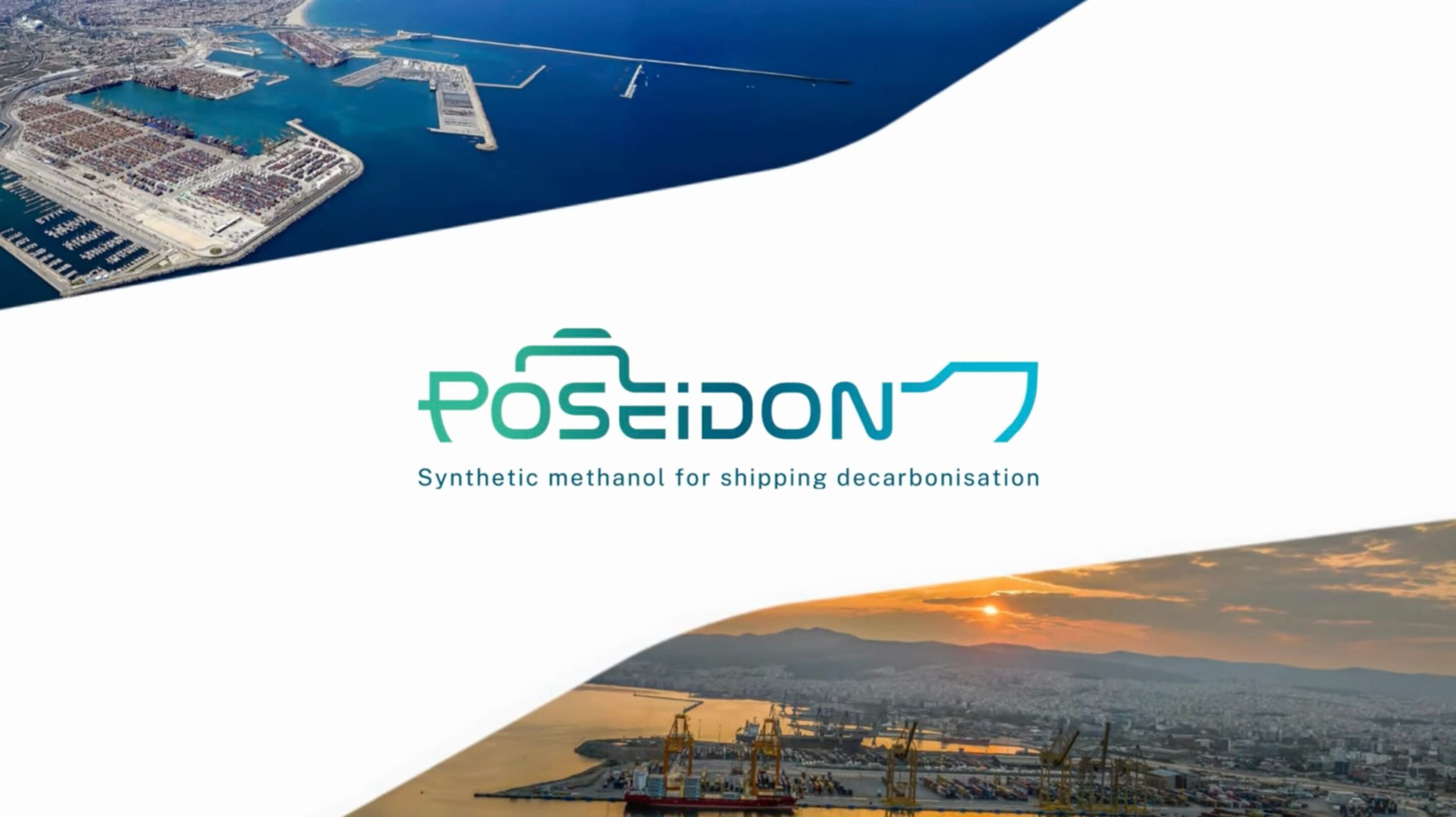
The School of Mechanical Engineering of Aristotle University of Thessaloniki — one of the three Schools contributing to the Materials Science & Engineering (MSEn) Integrated Master — participates in the Horizon Europe POSEIDON project, a major European research initiative with a total budget of €9.7 million.
The project focuses on one of the maritime sector's most urgent challenges: replacing fossil-based marine fuels with renewable alternatives. For MSEn students, it is a clear example of the research environment surrounding the programme — where materials, energy systems, process engineering and sustainability meet real industrial problems.
A €9.7 million European project.
POSEIDON — which stands for “Propulsion Of Ships with E-methanol In favour of the Decarbonisation Of Naval transport” — brings together 19 partners from seven European countries and runs from September 2023 to August 2027. Its central objective is to demonstrate innovative solutions across the renewable-fuel value chain, with a particular focus on e-methanol as a promising marine fuel.
Why e-methanol, and where it will be tested.
Within the project, two strategic port ecosystems — Thessaloniki in Greece and Valencia in Spain — will serve as pilot sites for the preparation of local e-methanol value chains. These pilots are designed to examine how renewable fuel production, storage, distribution and end-use can be organised in real port environments.
The project will also develop and test a scaled-up Power-to-Methanol pilot plant, capable of producing e-methanol from carbon dioxide, hydrogen and renewable power, while the produced fuel will be tested in two-stroke and four-stroke marine engines.
The role of Aristotle University of Thessaloniki.
Aristotle University of Thessaloniki participates through the Laboratory of Applied Thermodynamics of the Department of Mechanical Engineering. The Laboratory plays a central role in the project by leading the work package dedicated to assessing the implementation of e-methanol value chains in the ports of Thessaloniki and Valencia. This includes the synthesis of techno-economic, environmental and social analyses, as well as the identification of the most promising scenarios for each case study.
This role highlights the School's expertise in applied thermodynamics, clean transportation, vessel engineering and environmental engineering. As Mechanical Engineering is one of the Schools contributing to MSEn, projects such as POSEIDON also illustrate the wider research ecosystem in which MSEn students study — connecting advanced materials, energy conversion, industrial processes and environmental performance.
From research to industrial transformation.
Beyond the technical dimension, POSEIDON also aims to build strong local collaboration through communities of practice in Thessaloniki and Valencia. These communities will bring together stakeholders from academia, industry, ports, policy and society in order to exchange knowledge, identify barriers, and support the future deployment of e-methanol-based solutions.
The project will also produce roadmaps and policy recommendations to help other European ports assess and replicate similar value chains after the project ends.
The participation of AUTh Mechanical Engineering in POSEIDON reflects the University's broader research orientation towards clean energy systems, sustainable mobility and climate-neutral technologies. This is the type of interdisciplinary environment that also underpins MSEn: fundamental science, engineering analysis and materials-related innovation brought together around complex technological challenges.